Wiring
Over twenty-five years of wire pulled through Branch County walls, barns and shops
Agricultural, residential, commercial and industrial wiring, rewiring, and the low voltage work that gets forgotten until the drywall is up.
Chapter 01
Agricultural and outbuilding wiring is its own animal
A pole barn or shop is rarely close to the main service, and that distance is the first number that matters on the job. A feeder sized for a short run to a garage will sag under a longer run to a barn at the back of the property, so it gets sized for the actual distance, not a guess.
The location itself is the second issue. An outbuilding is wet, dusty, sometimes unheated, and sometimes shares space with livestock, which is a different environment than any room in a house. Boxes, connectors and protection all get chosen for that environment specifically, and a run that would be perfectly fine inside a finished wall gets treated differently once it leaves the house.
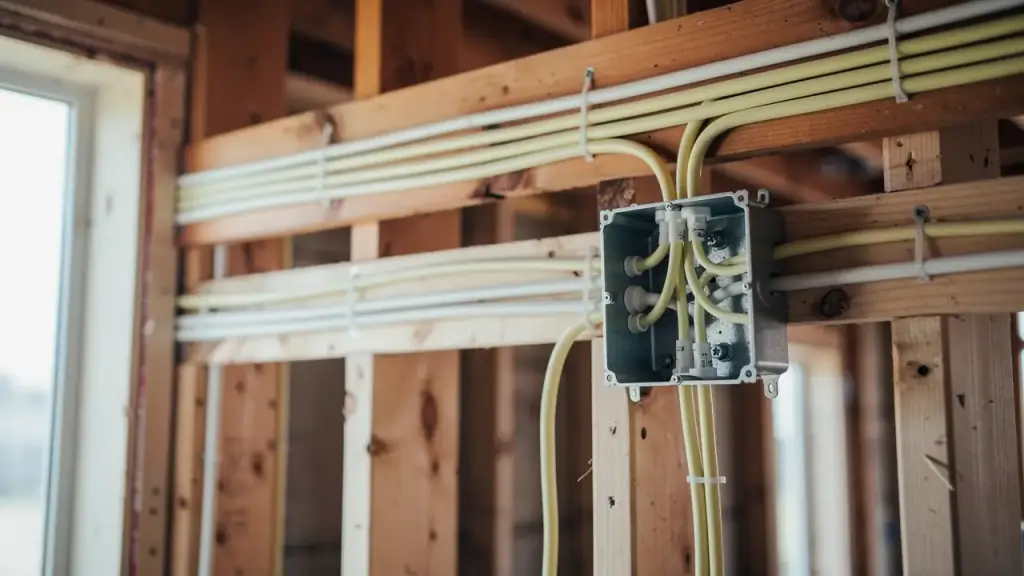
A residential electrical rough-in with non-metallic cable run through drilled studs into a metal junction box
Rewiring an older Michigan house
Older houses in this area tend to show up with the same handful of problems: two prong, ungrounded receptacles in rooms that were never updated, a panel that is already full before you add anything, and wiring that was fine for the load a house carried decades ago and is not fine for the load it carries now.
The work gets staged so the house stays livable while it happens, room by room rather than the whole place going dark at once. Panel capacity gets checked early, because that is usually the real constraint. There is no point finishing a room's new circuits only to discover the panel has nowhere left to land them.
Chapter 03
Low voltage, run properly
Telephone, data, television and home theater wiring go in at the same time as the power whenever possible, because that is the point in a job when walls are already open and a low voltage run costs a fraction of what it costs to add later.
Swimming pool wiring gets the same discipline generator wiring does: it is treated as its own circuit with its own protection, not an add-on to whatever happened to be nearby. Getting that wrong around water is not a place to cut a corner.
New construction and additions
The right time to call an electrician on new construction or an addition is before the framing is closed up, not after. Rough-in wiring happens while the walls are still open, which is also the point where moving a switch or adding an outlet costs almost nothing compared with doing it once drywall is hung.
If you are not sure where you are in the schedule, call and ask. It costs nothing to find out whether it is still the right time.
B&B Electric, Licensed and insured. Call (517) 369-2512.
How a wiring job actually runs
Four stops, whether it is a bedroom circuit or a barn feeder.
Walk it and count the loads
Before a run gets planned we walk the space and count what actually has to be fed. On a house that means every circuit already in the panel and every new one being asked for. On a barn or shop it means the distance from the main service, because that distance decides feeder size before anything else does.
Run it where it will not get chewed or soaked
Wire and cable get routed and protected for where they actually end up, not where a drawing says they should be. A run through a wet or dusty outbuilding location gets different protection than a run through a finished, heated basement, and a run that crosses a spot mice or livestock can reach gets treated accordingly.
Land it, box it, label it
Every run ends at a box that is made up cleanly and a panel legend that says plainly what it feeds. That last part sounds small until you are the next person standing at that panel during an outage, trying to work out which breaker actually kills the well pump.
Inspect it and hand it back
The work gets inspected, and you get told what passed and what, if anything, needed a second look. One customer's basement rewire is on record as taking the electrical inspector very little time, which is the outcome we aim for on every job, not a lucky one.
The same sequence applies whether the job started as a lighting call that turned into a circuit problem, or as a generator that needs its own feeder run. Call (517) 369-2512, or send a message to set a time, and read more about the shop on the about page.