Signs an Older Bronson-Area House Is Overdue for a Rewire
Flickering lights and a panel that runs out of room aren't cosmetic problems. They're the wiring telling you what it can't keep up with anymore.
September 10, 2026 · 4 min read
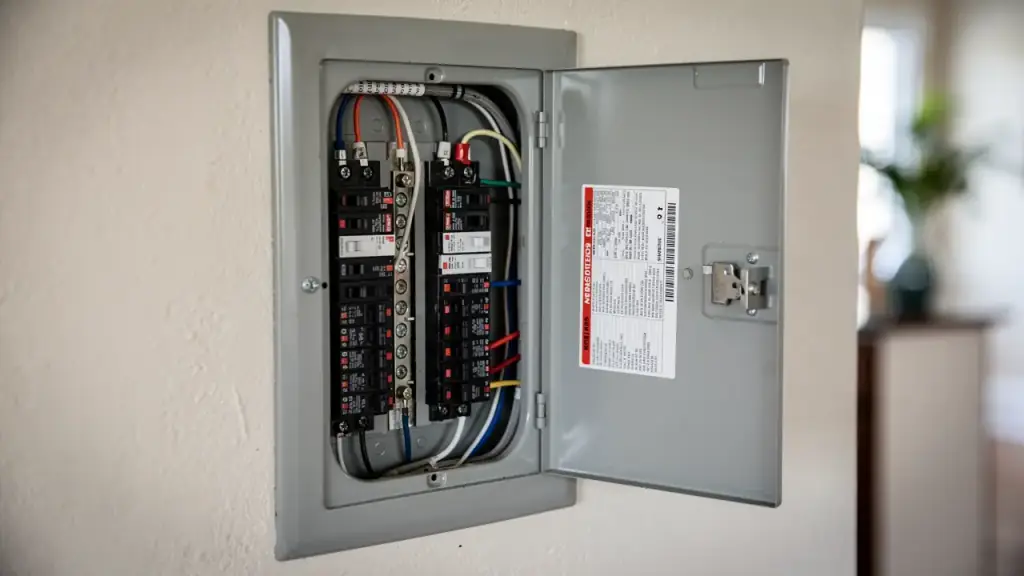
Branch County has a lot of older housing stock, farmhouses that have had three or four owners, homes built when a family's electrical load meant a few lights and maybe a radio. Those houses are still standing and still livable, but the wiring inside them was never designed for what a modern household actually runs. Nobody notices this gradually. It shows up as a specific, annoying moment: the lights dim every time the fridge compressor kicks on, or the microwave and the toaster can't run at the same time without tripping a breaker.
What the wiring is actually telling you
A handful of signs come up again and again in older homes. Lights that flicker or dim when a major appliance starts. A panel that's already full, with no room for a new circuit even though you'd like one. Breakers that trip for no obvious reason, or worse, breakers you've stopped noticing trip because it's become routine. Warm outlet covers or a faint burning smell near a switch. Two-prong outlets throughout the house instead of grounded three-prong ones. Any kind of buzzing or crackling from a switch or outlet. None of these are quirks of an old house you just live with. Each one is the wiring or the panel telling you it's being asked to do more than it was built for.
- Lights that flicker or dim when a big appliance starts up
- A breaker panel that's already full, with no room for anything new
- Breakers that trip repeatedly, especially ones you've quietly gotten used to
- Warm switch plates or outlet covers, or a faint burning smell
- Two-prong outlets throughout instead of grounded three-prong outlets
- Buzzing, crackling, or any sound from a switch or outlet that shouldn't make one
Why a rewire isn't an overreaction
The instinct with an old house is to fix the specific symptom. Swap the breaker that keeps tripping. Add a new outlet where you need one and call it done. Sometimes that's genuinely enough. Other times it's patching one spot on wiring that's failing generally, and the next symptom shows up somewhere else six months later. A rewire, done properly, isn't about distrust of the house. It's about bringing the electrical system up to what the house is actually being asked to carry now, decades after it was originally wired for a much lighter load.
A rewire doesn't have to mean living in a construction zone
This is the part that scares people off longer than it should. A whole-house rewire sounds like torn-open walls and a family living out of one room for a month. It doesn't have to be that. Work can be staged room by room, or by priority, so the kitchen and the panel get done first if that's where the strain shows up worst, and the rest follows on its own schedule instead of all at once. Access points get planned so drywall damage is limited and patched cleanly rather than opened up wall to wall. The goal on a real rewire job is a house you can keep living in while the work happens, not one you have to move out of.
Not all old wiring is the same kind of old
Part of what makes an older Michigan house tricky is that the wiring inside it might be several different generations layered on top of each other. Some farmhouses still have a section of knob-and-tube wiring tucked in an attic or a wall cavity that nobody's touched since it was installed, usually because it's out of easy reach rather than because it was ever properly retired. Others have runs of old aluminum branch wiring from an era when that was a common material choice, which behaves differently at a connection point than the copper wiring used almost everywhere today. Neither one means the house is unsafe by default, but neither one should be assumed fine just because it's been sitting there quietly for decades. Figuring out what's actually behind the walls, room by room, is part of the same walk-through that identifies where a rewire should start.
Starting with the panel, not just the outlets
A lot of what an old house needs starts at the panel itself. An outdated or undersized panel is the ceiling on everything downstream of it, no matter how good the individual circuits are. Bringing the panel up to a modern standard, with enough capacity and enough open breaker slots, is often the first real step, even before individual rooms get touched. It's also the piece that a licensed inspector is going to look at closely, and getting it right the first time means not having to revisit it later.
If any of the signs above sound like your house, the smart move isn't to guess whether it's serious. It's to have someone actually look at the panel and walk the rooms with you, figure out what's original, what's already been touched, and what the real priority order should be. The estimate is free, and it starts with exactly that walk-through.
B&B Electric of Bronson, (517) 369-2512
Call (517) 369-2512More articles
How Big a Generator Does Your Bronson House Actually Need
Before anyone talks Generac models or price, the real question is what has to keep running when the power drops.
Wiring a Pole Barn or Outbuilding on a Rural Michigan Property
A barn isn't a smaller version of a house circuit. Distance, moisture and how the space actually gets used change the whole plan.