How Big a Generator Does Your Bronson House Actually Need
Before anyone talks Generac models or price, the real question is what has to keep running when the power drops.
September 10, 2026 · 4 min read
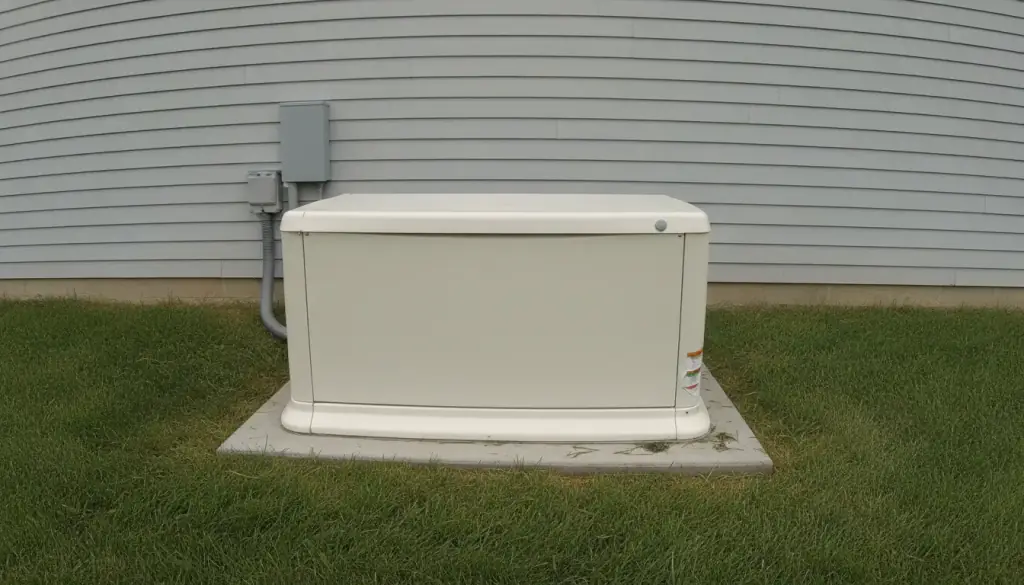
Every winter, Branch County loses power somewhere. A line comes down under ice, a transformer trips, a storm rolls through and takes out a substation for half the county. Most of the time it's back in an hour. Sometimes it's back in three days. The people who don't think about it twice are the ones who already have a standby generator wired in. The rest spend that stretch running a portable unit off the porch with an extension cord snaked through a cracked window, hoping the sump pump doesn't quit at 2 a.m.
Sizing starts with a list, not a wattage number
The instinct is to ask 'what size generator do I need' like it's a single number you can look up. It isn't, because the answer depends entirely on what has to keep running in your specific house. A furnace blower and igniter draw differently than a well pump kicking on. A refrigerator and a chest freezer together pull more at startup than they do once they're humming along. Add a sump pump, especially on a property that already floods when the ground's saturated, and the list gets serious fast.
So the real first step is walking the house and building that list room by room, panel circuit by panel circuit. Furnace or boiler. Well pump if you're on one, which a lot of homes outside town are. Sump pump. Refrigerator, freezer. A handful of lights and outlets so the house is livable, not dark. Garage door opener if it matters to you. For a farm or a property with outbuildings, the list might also include a barn heater, a stock tank waterer, or whatever's keeping livestock alive through a cold snap.
Whole house doesn't always mean whole house
Here's where a lot of people overthink it. 'Whole house generator' is the product category, not a promise that every single outlet in the home runs at full draw simultaneously during an outage. Most installs are set up to carry the essentials plus real comfort, not to run the house exactly like nothing happened, including the hot tub and both AC units at once. Getting that balance right, essentials covered without paying for capacity you'll never use, is the actual point of a proper sizing conversation before anything gets ordered.
That's also where a transfer switch comes in. It's the piece that decides which circuits the generator picks up automatically and which stay off the generator entirely. A well-planned transfer switch setup means the generator doesn't have to be sized for everything in the panel, only for what's assigned to it. Get that assignment wrong and you either pay for more generator than you need, or you find out mid-outage that something you assumed was covered wasn't.
What the walk-through actually looks like
In practice, this is a conversation more than an inspection. We look at the panel, talk through what runs on which circuit, and ask the questions that actually change the sizing: Is there a well pump? Does the basement flood? Is anyone in the house on medical equipment that can't lose power? Is this a farm with animals depending on power for water or heat? None of that shows up on a spec sheet, and none of it should be guessed at from the outside.
- What has to run without interruption (medical equipment, a sump pump on a flood-prone lot)
- What has to run but can tolerate a short delay (furnace, well pump, fridge)
- What's nice to have but not essential during a short outage (a second AC unit, a garage freezer)
- Anything seasonal that changes the answer, like barn heat in winter or well irrigation in summer
The install matters as much as the size
A generator that's sized right but installed poorly is still a bad outcome. Placement matters for clearance and noise. The transfer switch has to be wired correctly against the exact panel it's protecting, not a generic diagram. And a generator that sits unused for eleven months a year needs to actually start when the power goes out in month twelve, which is a maintenance question as much as an installation one. Ask about the warranty when you get your estimate, since that's the piece that protects you after the install is done.
None of this is complicated once someone's actually looked at your panel and your house, and it's exactly why a phone quote based on square footage alone is never going to be right. If you're weighing a standby generator for a house, a farm, or a shop anywhere around Bronson, the estimate is free and it starts with the same list above: what has to stay on, and what's the plan for the rest.
B&B Electric of Bronson, (517) 369-2512
Call (517) 369-2512More articles
Wiring a Pole Barn or Outbuilding on a Rural Michigan Property
A barn isn't a smaller version of a house circuit. Distance, moisture and how the space actually gets used change the whole plan.
Signs an Older Bronson-Area House Is Overdue for a Rewire
Flickering lights and a panel that runs out of room aren't cosmetic problems. They're the wiring telling you what it can't keep up with anymore.