Wiring a Pole Barn or Outbuilding on a Rural Michigan Property
A barn isn't a smaller version of a house circuit. Distance, moisture and how the space actually gets used change the whole plan.
September 10, 2026 · 3 min read
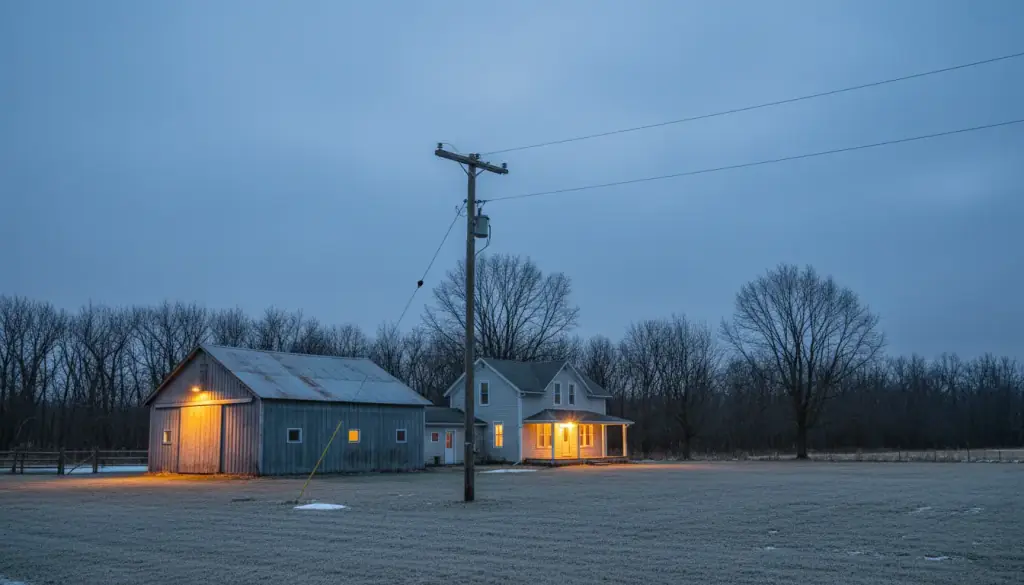
Out past the edge of town, most properties have at least one building that isn't the house. A pole barn for equipment, a workshop, a machine shed, a run of stalls with a tack room off the side. At some point almost everyone with one of these buildings decides they want real power out there instead of a string of extension cords running across wet grass to a garage outlet. That's usually the moment they find out that wiring an outbuilding isn't a scaled-down version of wiring a house. It's its own job, with its own set of problems.
Distance changes the math before anything else does
The first thing that's different is simply how far the power has to travel. A run from the house panel out to a barn thirty, sixty, or a hundred-plus feet away isn't the same as a fifteen-foot run inside a wall. Wire has resistance, and resistance over distance means voltage drop, which means a run that's undersized for its length can leave equipment out in the barn running hot, dim, or underpowered even though everything's technically connected. Getting the conductor size and the run length right together, instead of just pulling whatever's on the truck, is most of what separates a barn that runs a compressor and welder fine from one that trips breakers every time two things kick on at once.
Underground versus overhead is a real decision, not a formality
Overhead service between the house and a barn is faster to install and often cheaper, but it means a wire strung over a yard or a driveway that a tall implement, a grain truck, or a low-flying storm branch can catch. Underground gets the wire out of the way entirely, at the cost of a trench and burial-rated cable. Which one makes sense usually comes down to the layout of the property, whether there's already equipment crossing that path, and what the land does when it's wet, since a low spot that holds water changes how a trench behaves.
A working building is a harder environment than a house
Inside the barn, the circuit has to survive what actually happens in a barn. Dust from feed and bedding. Damp from washdown or just a Michigan winter's condensation swings. Vibration from a compressor or an auger. None of that is friendly to the same wiring methods that are perfectly fine behind drywall in a climate-controlled house. Fixtures, outlets, and panels rated for a rough, occasionally wet, sometimes dusty space hold up; residential-grade parts pulled from a house job don't, and they fail in ways that aren't obvious until something stops working, or worse.
- How far the run is from the source panel, and whether that changes the wire size needed
- Overhead versus underground, based on how the property is actually used and crossed
- What the building gets used for, since a machine shop pulls differently than stalls or storage
- Dust, moisture and vibration exposure inside the space
- Whether lighting, a garage door opener, or equipment like a welder or compressor needs its own dedicated circuit
Plan for what the barn becomes, not just what it is today
The other thing worth thinking through before the trench gets dug or the wire gets pulled is where the building is headed. A shed that's storage today might be a shop with a welder and a compressor in three years. A stall barn might eventually want heated water lines or better lighting for evening chores in the dark months. Running a slightly larger service and a panel with a couple of spare breaker slots now costs a lot less than tearing back into a finished run later because the load outgrew what was installed.
This kind of work, agricultural and outbuilding wiring, new circuits out to a barn, feeders for equipment, is exactly the category of job that gets done wrong by someone guessing at wire size over the phone. It gets done right by someone walking the property, looking at the distance and the building, and planning the circuit for what's actually going to run through it. If you've got a barn, shop, or outbuilding anywhere around Bronson that's still running off an extension cord, the estimate is free and the conversation starts with a walk out to the building itself.
B&B Electric of Bronson, (517) 369-2512
Call (517) 369-2512More articles
How Big a Generator Does Your Bronson House Actually Need
Before anyone talks Generac models or price, the real question is what has to keep running when the power drops.
Signs an Older Bronson-Area House Is Overdue for a Rewire
Flickering lights and a panel that runs out of room aren't cosmetic problems. They're the wiring telling you what it can't keep up with anymore.